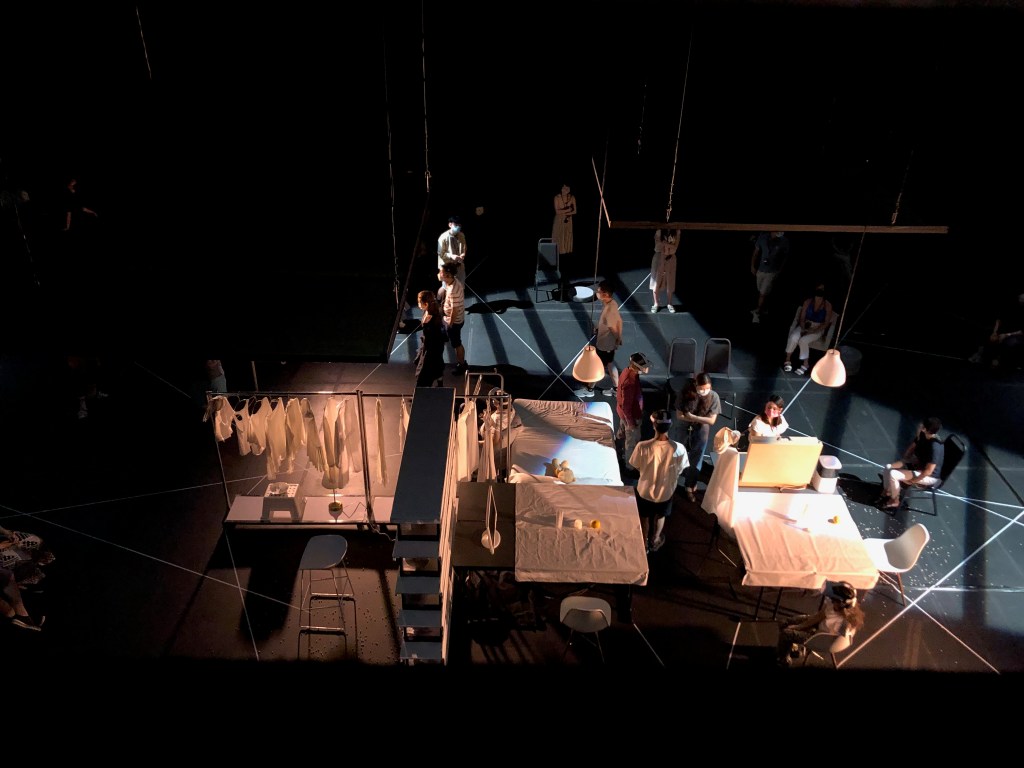
the core objects and the overlapped setting
It all began with the note from the director team as “there should be a series of related/unrelated objects”, and a narrative slowly emerges and connecting these objects together to create the setting. It was never the idea of a simple “room” or separated “scene” but conceived as an overlapping cluster of 4 different narratives that is linked with a common thread.
the peripheral and the marginal objects
Then it comes the peripheral and marginal objects. Vaguely associated with the additional fragment dialogues, it was a series of common objects that could make nice or prompt people (audience) to interact with. The core cluster is transformed from a rich and colourful “real” world in the virtual world to an abstract and monochrome landscape. The overwhelming junk from the narrative became neatly displayed white items, as a pure canvas for light and sound to act on.
the audience to intervene
The set came into life when the audience enter. Without specific prompt for action or expected behaviours, these static objects became the protagonist together with audience. Cans and bottles are opened and used as musical instruments; T-Shirts on the shelf is spread out; toilet paper became being rolled out and circle around the stage or tied as ribbon on a bar; the coat on the hanger is worn by an audience; the chairs are rearranged as a cluster and piled up with the ballet barre….. none of these were scripted, and each session gives a quite different end scene.
The light and sound are traditional stage element but being used in a non-linear way and not for the purpose to produce dramatic effects. Instead of recreating scenery of what one hear in the earpiece, they are abstract elements that build up an atmosphere, another layer of fragments that might or might not be related.
All these seemingly meaningless bits and pieces are to be connected, not by the creator but by the audience. We would call them participants instead of “audience”. What story you would take away depends on both by chance (what channel in your earpiece) and by self and crowd action (what do you and others decide to do). If there is a “morale of the story” (and there is none), it is probably this intention of taking initiative, and to chance the environment. The theatre is a container and the piece provides a framework, welcoming those who come to share a common experience, to reconcile with your inner self, while creating your own story.
The reflective surface double up the image. But it is distorted, either you look straight into it or up towards the sky, what do you find in there?
 threshold 內外之間
Leave a comment